
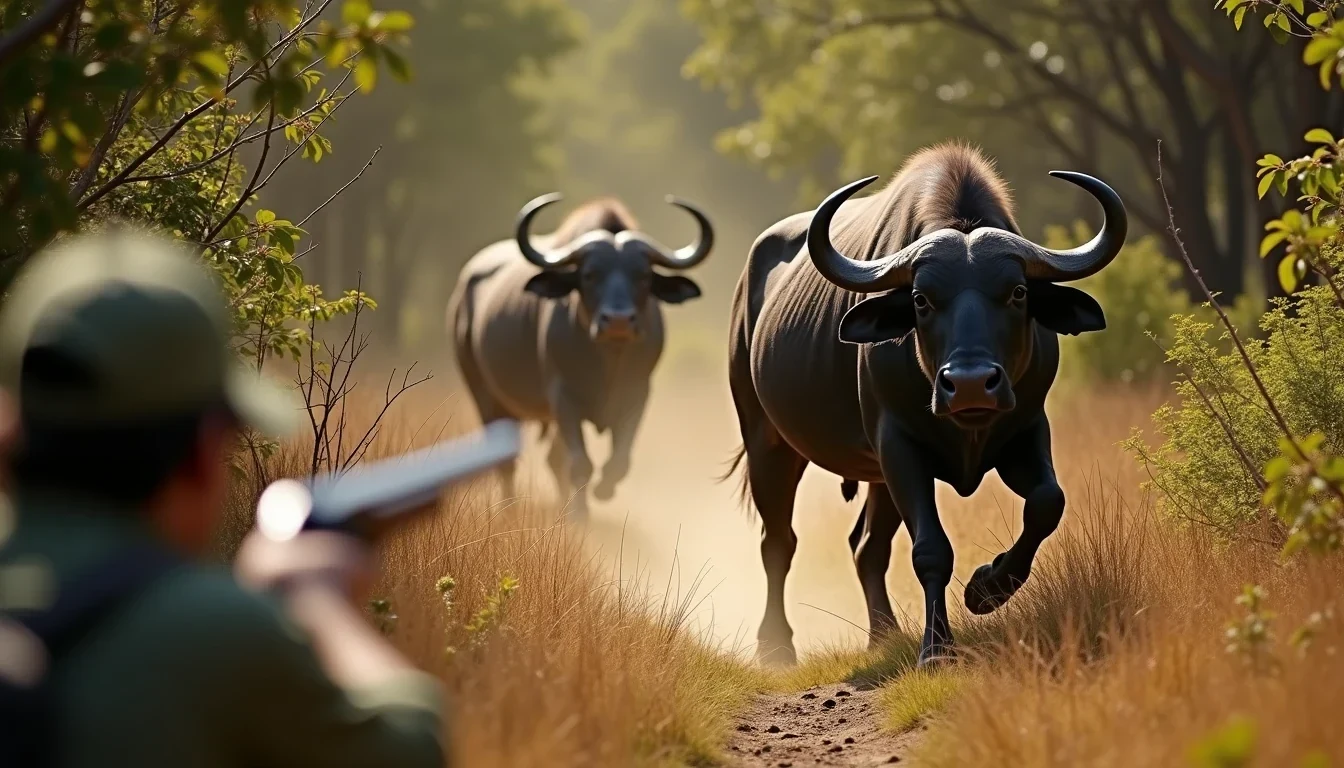
A 52-year-old luxury ranch broker from Texas built his online brand on dead animals. Asher Watkins spent years posting photographs of himself beside fallen wildlife across multiple continents, turning the killing of exotic species into content for a growing audience. The hunt that killed him was supposed to add another entry to that catalogue. Instead, an uninjured African buffalo in Limpopo province charged before Watkins could raise his rifle, delivering a single fatal blow that made him the subject of the kind of story he used to share.
Why the Buffalo Earned Its Name
The African buffalo carries a nickname that sounds theatrical until you examine the statistics. “Black Death” refers not to disease but to body count. These animals have killed more hunters than any other species on the continent, a figure that becomes less surprising once you understand their behaviour.
At 500 to 900 kilograms, with horns fused into a solid bone boss across the forehead, a buffalo presents a physical challenge before it moves. The boss deflects head-on shots that would drop other game. Their charge reaches 55 kilometres per hour. Their senses of smell and hearing make close approach difficult even for experienced trackers.
The psychological profile matters more. Buffalo do not reliably flee when threatened. They circle back through dense cover. They feign retreat to set up ambushes. They target the hunter rather than the threat. Watkins faced an animal that was not wounded, not cornered, not provoked by any standard protocol, yet attacked with complete commitment. The safari operator’s description of the event as sudden and unexpected matches every other account of buffalo behaviour. The unpredictability is the point.
What Hunting Protocols Actually Cover
South African law mandates specific protections for dangerous game hunts. A licensed professional hunter leads every expedition. An armed backup rifleman stands ready to intervene. Clients receive detailed briefings on firearm handling, shot placement, and emergency procedures. Minimum calibres are enforced, typically .375 H&H Magnum or larger for buffalo. Communication devices and evacuation plans are standard equipment.
These rules address human failure. They cannot override animal initiative. A charge from dense cover reduces reaction time to fractions of a second. Terrain and vegetation obscure sightlines. The buffalo that killed Watkins acted faster than any protocol could respond, illustrating a category of risk outside operational control.
The professional hunter involved now faces licence review. The operator faces permit scrutiny, potential civil action, and reputational damage that will outlast any investigation. Insurance premiums will rise. These are the predictable consequences of an unpredictable event.
The Economics and Ethics of the Trade
Trophy hunting generates approximately $100 million annually in South Africa. Proponents channel this figure toward conservation arguments: anti-poaching funding, habitat preservation on private land, employment for trackers and camp staff, and community infrastructure in rural areas where alternative revenue is scarce. Wildlife must pay for its own protection, and hunting provides that income stream.
The counter-argument questions whether the same land and animals could generate comparable returns through non-consumptive tourism. Photographic safaris, guided game drives, conservation volunteering, and specialised birding tours all operate without firing shots. They carry different risk profiles, different skill requirements for staff, and different price points per visitor. The comparison is not straightforward, but it persists because incidents like Watkins’ death force a reckoning with what the consumptive model costs.
CITES Appendix II regulates international trade in buffalo trophies, requiring export and import permits. This framework treats the species as manageable through controlled offtake. It does not address whether individual hunters should participate, or what happens when the controlled encounter becomes uncontrollable.
What the Incident Reveals About the Culture
Watkins’ online following existed because hunting content attracts engagement. The photographs he posted, the locations he visited, the species he collected, all functioned as credentials within a community that measures experience by tally. The buffalo that killed him was intended to join that record. Instead, the record became his obituary.
This reversal exposes a tension in how hunting is marketed and consumed. The danger is part of the appeal. The “Black Death” nickname sells expeditions. Clients pay premium rates precisely because buffalo are described as the most serious challenge available. Yet the same operators who emphasise risk must also guarantee safety, a combination that works until it does not.
The Limpopo province where Watkins died is a known hunting destination. The operator who hosted him ran a licensed, regulated business. Nothing in the initial reporting suggests illegal conduct or obvious negligence. The failure was biological, not procedural. An animal with no recorded injury, no trapping history, no provocation within the hunt’s documentation, simply chose to attack. That choice is within normal buffalo behaviour, which is why the behaviour generates both revenue and mortality.
Safer Ways to Encounter the Same Animals
South Africa’s wildlife tourism infrastructure offers multiple alternatives to hunting. Safari game drives in Kruger National Park and private reserves keep visitors in vehicles, maintaining distance while providing observation access. Photographic safaris optimise positioning and timing for image capture rather than shot placement. Guided bush walks with armed rangers focus on tracks, flora, and smaller species, with protocols for avoiding dangerous encounters rather than seeking them.
Conservation volunteering places participants in research and anti-poaching support roles. Cultural tourism diversifies revenue streams for communities near wildlife areas. None of these options eliminate risk entirely. All of them shift the risk profile away from deliberate confrontation with animals specifically selected for their dangerous reputation.
The buffalo that killed Watkins was not defending a calf, not protecting territory, not responding to a wound. It charged an armed human who had not yet fired, for reasons that remain unknowable. That unknowability is what the nickname describes. The “Black Death” is not a metaphor for disease. It is a practical acknowledgment that some animals cannot be fully prepared for, only encountered, and that the encounter sometimes ends one way only.